


26 June 2026 - New publication in The Astrophysical Journal
Crystallization of Amorphous Olivine: Why Is It Faster with Iron
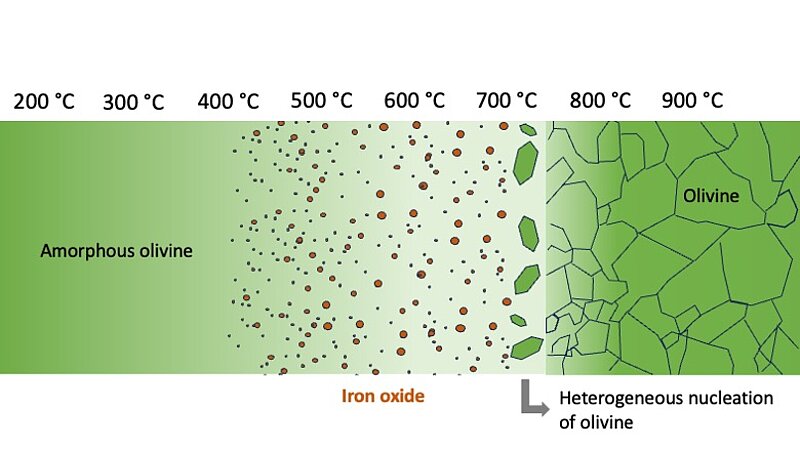
A new article published in The Astrophysical Journal explores how amorphous olivine, one of the major silicate components of cosmic dust, transforms into its crystalline form during heating. Using in situ transmission electron microscopy, the study follows this transformation at the nanoscale and shows that iron plays a decisive role.
Rather than crystallizing directly, Fe-bearing amorphous olivine first undergoes a subtle chemical reorganization: iron-rich nanocrystallites form within the glassy matrix at relatively low temperature. These nanocrystals then act as seeds that promote the crystallization of olivine at higher temperature. This mechanism helps explain why Fe-bearing amorphous silicates crystallize much faster than Fe-free compositions.
Beyond the laboratory experiment, the results provide new constraints on the thermal and chemical evolution of silicate dust in protoplanetary disks, where amorphous interstellar grains are progressively transformed into crystalline minerals.
Read the full article for the detailed experimental observations and interpretation:
P. Cordier, N. Gauquelin, A. Kashiwar, I. Ul Haq, A. Gomez Perez, G. Lumbeeck, A. Orekhov, P. Pratim Das, V. Delbecq, D. Schryvers, J. Verbeeck, P. Carrez & H. Idrissi (2026) Crystallization of Amorphous Olivine: Why is it Faster with Iron ? The Astrophysical Journal, 1005 :87, https://doi.org/10.3847/1538-4357/ae71bd